Monday, November 10, 2014

Homework BEFORE the Holidays- avoiding ANAPHYLAXIS

Thanksgiving and Christmas are often the allergic person's most feared social events of the year. Unless you make everything yourself, you really never know how allergy- safe holiday food is.

In past years, I've discussed Surviving the Holidays with a Coconut Allergy.  But, I mainly focused on which coconutty foods to avoid.  This year, I want you to give yourself the gift of enlisting your family or friends in becoming your allergy advocate.  

Here is how you can train others to make your life less lame during social meals:

First, show your family or friends this interactive guide on Healthline:
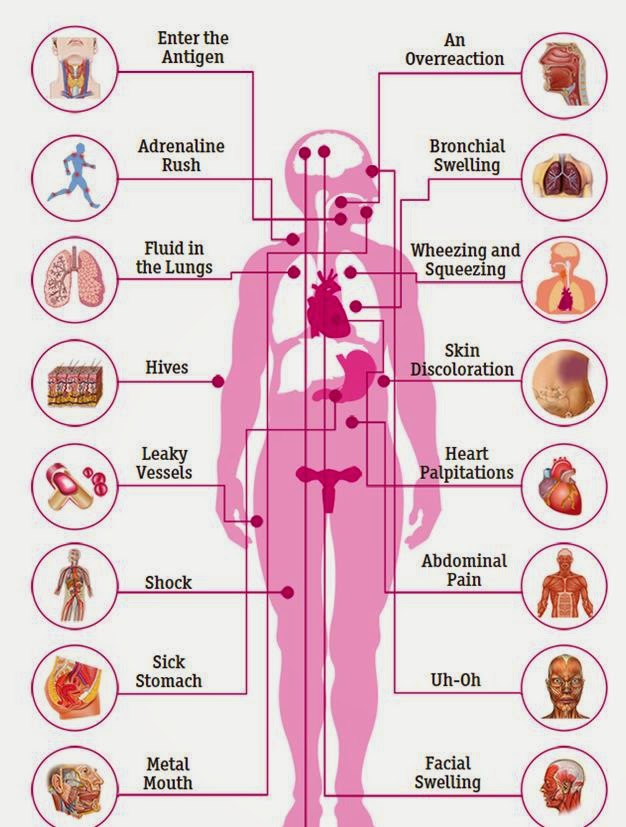


This guide will help them know what life threatening symptoms could possibly be caused by your allergy.  

Second, dig out your PRACTICE EPI PEN and all of your other meds (Benadryl, Steroids, etc). And show them how to save your life if it ever happens to you.

Next, tell them how NOT FUN it is for you to always have to be the one defending yourself against potential allergens in food.  Give them lists of foods you are allergic to on paper, or keep a list on your iPhone that you can text them. 

Finally, when it's time to eat, put THEM to work.  It will now be their responsibility to make sure you easily find safe food.  Ideally, your loved ones should come up to you at the beginning of a shared meal or party, point out what they brought to eat,  and tell you whether or not it is something that you can safely eat.  Remind them that it's totally fine if they bring something you can't eat, as long as you know you can't eat it.

The icing on the cake comes when you go out to eat and your companions get the allergy menu for you, they remind the server of how serious your allergies are, or they call the restaurant ahead of time to make sure the chef can prepare something you can eat.  

Allergies are rough during the holidays.  Hopefully, once you enlist and train others who are willing to go to bat for you, it can be less lame.  Friends who stick up for friends with allergies are showing so much needed love during a holiday; and that is a gift money can't buy. 

Wednesday, April 9, 2014

Coconut free soap fan mail from Melissa

Thank you again for your note, Melissa!  With her permission, I will share her email since it is pretty much how we all feel about slimy alternative soap (see below):

I wanted to thank you for your blog at coconutallergy.blogspot.com.  My husband has a coconut allergy, which seems to be somewhat uncommon as he’s not allergic to any other kind of nuts, only coconut.  His throat will swell if he eats whole coconut, he will get sick to his stomach if he eats movie theater popcorn that’s popped in coconut oil, his skin will break out on contact if he uses shampoos or other products that contain coconut oil.

I’ve gotten away from using most commercial or non-organic cosmetics, shampoos, lotions, and soaps.  If my local health food store won’t carry it, I don’t want it on my skin.  My biggest stumbling block has been bar soap.  The vast majority contain coconut oil, because of its moisturizing properties and the thick, rich lather it creates.  My only alternative has been castille/olive oil soap, but my husband doesn’t like it because it’s ‘slimy’.

I’ve finally found a solution, and that’s soap made by One With Nature ( www.onewithnature.com ).  I use the lemon sage and love it!  It has an amazing scent and is husband approved.  Much better than the ‘slimy’ Kiss My Face olive oil soap I was using before.

Just to be sure before I purchased the soap, I contacted the company to be sure that they were coconut free.  They confirmed that the formula for all their soaps (except for ‘Coconut Lime’) did not contain coconut.  Most use palm oil, and some also contain argan oil, but no coconut.  You can see the response below.

Hope this helps!

~Melissa

--------------------------------------------

Good Morning Melissa, 


Our Bar soap products (4oz and 7oz size ) are both made in Jordan and then

shipped to the United States.  Our lotion, Hand Washes and Body Washes are

made in the United States with Dead Sea Salt brought in from Jordan.  The

same can be said for our Dead Sea mineral Bath Salts. 


We do have a line of our products that is called Coconut Lime.  As you are

aware, we recommend you to not use this line. 


We used to have a bar soap called Coconut Milk but this was discontinued 


All of our other bar soaps SHOULD be Coconut Free.  There SHOULD not be

cross-contamination.  But we do not guarantee the production line in the

warehouse. 


We recommend that you test a small area on your body to double check for any

allergies that some people have to natural fragrances. 


If there is a particular scent which you prefer, I can provide the

ingredients list to you. 


If you would like more in depth information on the ingredients used, One

With Nature utilizes the International Nomenclature of Cosmetic Ingredients

(INCI) I have provided the link for your reference. 


http://www.makingcosmetics.com/articles/INCI-list.pdf


Thank you for your inquiry. 


Stacie Swarner

One With Nature

Director of Business Operations 

Tuesday, April 8, 2014

How to Substitute Out the Coconut in Recipes

Something that has been on my mind a lot lately is the amount of coconut oil showing up in recipes.  I often joke with people that I totally wouldn't mind being a vegan, but I can't, because I'm allergic to coconut. Seriously, it's in everything these days because it's been marketed as the newest "healthy" fat.

I would like to provide some reassuring yin to the yang for all of us who are longingly wishing we could march along in the coconut oil parade.  I cook pretty much everything from the periodic table because of my allergies, so, not to brag, but my time in the kitchen has taught me many things about making good food that doesn't taste at all tropical.


  • Virtually ALL oils contain less saturated fat than coconut oil.  It's considered a SOLID fat even though it is liquid at room temperature.
  • One tablespoon has 11.8 g of saturated fat, .8g monounsaturated fat, and .2 grams of polyunsaturated fat.  It has only trace amounts of nutrients.  It also has 117 calories.  Genuine butter has 102 calories, and 7g of saturated fat, .4 polyunsaturated, 3g of monounsaturated, and .5 g of trans fat. 
  • Coconut oil has a neutral, not beneficial effect on cholesterol.  It raises both good and bad cholesterol.
Now that we are less sad that we are allergic to it, what do we do with it in recipes that we want to try?  Well, it depends entirely on the recipe!  
  • Coconut Oil-  substitute butter, shortening, or other vegetable, canola, etc oils.
  • Coconut Milk- substitute whole milk, or non-dairy milks (paying attention to the flavor of the milk)
  • Shredded coconut- this one really depends on what you are making!  For example, if you want to alter the frosting on a german chocolate cake, just add extra nuts to the frosting instead (try slivered almonds), OR sunflower seeds, dried shredded fruit (like thinly sliced apricots), or rolled oats.
  • Coconut flour- regular wheat flour, or a combination of gluten free flours (let me know if you need help with this because you'll need to keep it high in protein and fiber, so adding flax seed and soy flour will help any rice flour mix)
For stand alone cake forms, look for a pound cake type recipe with real butter. 

Baking
When subbing coconut oil in baked goods, look at the end result and the amount of fat in the finished product, for example:
MOST FAT= like brownies  - use butter or margarine
HIGH FAT= like cookies or biscuits- use less butter or margarine
MODERATE FAT= like muffins - use oil
LOWER FAT= cakelike - use oil or cream
NON FAT= like cardboard if you leave it out

Usually, you can make baked goods hold together and have a slightly more cakelike texture if you substitute applesauce.

In baked goods, depending on the item, you can use melted butter, shortening, cream, yogurt, applesauce, milk, or milk substitutes.  It all depends on what you are making and how much fat you want to eat.  The end texture will be more like cake as you remove the saturated fats.  

What is killing me recently is the amount of recipes that call for butter AND coconut oil.  That gets kind of confusing.  I usually just add milk or cream and end up with something slightly more (and delightfully) fluffy than it is probably supposed to be.

 If you have a recipe you want to send me, I can give you advice on what to sub out. 


Wednesday, May 29, 2013

Coconut-free Makeup?

A question I often discuss with many of you offline via email is MAKEUP!

Most make-up companies usually don't list the ingredients for the world to see. So, if you want to go to the drug store to shop for make-up, you will probably find it to be a frustrating and mysterious experience.
However, I have had great success and patience from workers at Origins stores, since they have their own storefront for just their brand.  However, don't try to get much from their online representatives.  All of my requests for ingredients have been redirected to the point of being completely ignored if I try to get them emailed to me.  Also, a good Mary Kay representative will be able to go into their personal computer system and search for ingredients that you are allergic to and see which products use them.  This has been how I get the only makeup I have found to work for me.  But, believe me, I really don't use much makeup anymore.

MASCARA= No, thank you.
I remember the first allergic reaction I had to some mascara (all mascara that I have found has SLS in it or something coconut related to make it slippery).  About a half hour after I put it on, it made me feel like my eyelids were being peeled back over the top of my head.  It burned!  This was, most likely, a sign as a teenager that I had a coconut allergy.  Mascara is just so risky if you're allergic to coconut.  If you MUST glam it up in the eyelash realm and aren't sensitive to adhesives, try some falsies.  They really are fun, can look pretty natural, and actually in fashion right now (well, depending on where you live in the country).  If you live in a big city you can even find salons who will glue them on for you!

LIQUID FOUNDATION= Avoid it.
Another makeup item to watch out for is cover-up or foundation.  In its liquid form, it contains SLS as well.  A good alternative is pure mineral makeup.

LIPSTICK= Take time to sort through them.
I find that about half of lipsticks have coconut ingredients.  Look for lipstick that you can sharpen with the big pencil sharpener, rather than the extra creamy stuff in the regular lipstick tubes.  Many of the pencil lipsticks still have Coco-something or rather.

EYELINER= Maybe, maybe not.
Liquid eyeliners, like lipsticks, tend to have more allergenic ingredients.  So, stick with the ones that are in pencil form, and research labels carefully.

EYE SHADOW= Yes, please!  But only if powder.  Still double check, but I haven't ever found a powdered eye shadow that had anything coconutty in it.  Cream eye shadows would be more iffy.

FACE POWDER- Safe :-).  This may be your go-to makeup item.  Powders usually have very few ingredients, mostly talcum, minerals, and tints.  Not usually anything coconut-related.

BLUSH- Usually safe, if powder

As you can see, most of the purely powdery makeup is safe.  You can make it work better if you skin is dry by applying a moisturizer that you aren't allergic to (nutrogena seems to work well) right before you put on the powder to help it stick.  You can even mix your powder with your moisturizer.

Experiment, and let me know what you've been able to come up with!  Let us all know what your favorites are.

Wednesday, February 27, 2013

LEAP MRT testing

I recently had a test that my new allergy doctor suggested to try and figure out some of my more serious, delayed reactions to foods.  It was really cosmic to see how accurate it was in finding the foods that bothered me, when the other common blood tests didn't show anything.  However, it didn't show a big reaction to coconut.  It is called LEAP MRT, which stands for Lifestyle, Eating, and Performance Mediator Release Testing.  It tests your blood over time to see whether it reacts by releasing mediators like histamine, cytokines, and/or prostaglandins when it contacts the food.  It doesn't say which kind of mediator is released, just that it happened.

My doctor has said this test has helped a lot of people, so I thought, why not go for it even though I had to pay for it all out of pocket.  The test alone cost me $295!  Not cool that even my slick PPO insurance doesn't cover it, but I was so intrigued, I had to spring for it.

It shows your reactions to more than a hundred foods and chemicals in green, yellow, or red, depending how your blood reacts to the trigger.  Here are some of my results for an example.  This is just for fun, because everyone's reactions will be vastly different, so my results will  not be anything like yours if you had the test.


This was the only test out there that shows chemical sensitivities, which I wasn't really worried about, but now I know that I have probably issues with some artificial colors.

Although coconut is on there and not considered really reactive as far as these mediators (even though if I eat or touch it I will have a textbook allergic reaction), maybe I should start worrying about sesame!
Here the section that shows my nemesis, wheat.   The only other things I was in the red zone for were peanut and tapioca.  I didn't realize I was having trouble with tapioca, since it's in all my gluten free bread. Darn!  

The question is, why did I not react to coconut in this test?  That is because this test shows a different type of reaction than the other allergy tests.  Although I will test positive on a skin test to coconut, it could be because my allergy is through mast cells and a tissue reaction rather than a blood reaction.  I am learning that there are so many different types of allergic-type reactions including things that are real reactions that doctors don't have a label to give to yet, so they just call them sensitivities! 

In any case, this test is mostly marketed to people with IBS or migraines, but it supposedly can help people with autoimmune issues, autism, ADHD, chronic congestion, etc.  So, I guess I have a few more foods to watch out for. 

The program intends for you to work with a nutritionist to plan your meals and do an elimination/ reintroduction diet.  That would cost me an extra $100 and the booklet explains how to do this, so I am going to set out to do it myself.  The real benefit to this is that the booklet has already included which foods for me to introduce when, so they already did most of the work.

Sunday, December 30, 2012

Mashed Potato Warning!

Thank you for the tip, S. Stonebridge.
Some Idahoan mashed potatoes contain coconut oil.  Make sure to read all ingredients on all packaged food!
For example, the "buttery golden selects" seem to be sharing secrets on making buttery flavor from our old nemesis, movie theater popcorn!


Ingredients

Idaho® potatoes (russet and gold varieties), partially hydrogenated oil (contains one or more of the following: soybean, cottonseed, sunflower), corn syrup solids, salt, maltodextrin, coconut oil, sugar, nonfat dry milk, whey powder, sodium caseinate, butter powder [butter (sweet cream, salt, annatto color), nonfat milk solids, sodium caseinate and disodium phosphate], mono and diglycerides, calcium stearoyl lactylate, natural and artificial flavor, spice, sodium acid pyrophosphate (preserve freshness), sodium bisulfite (preserve freshness), dipotassium phosphate, soy lecithin, artificial color, citric acid, mixed tocopherols (preserve freshness) and less than 2.0% silicon dioxide added as an anti-caking agent.

Monday, December 3, 2012

Morrocco Method Shampoo and Conditioner

Our friends at Morrocco Method sent me a sample of their Chi Essence Shampoo and Pearl Essence Creme Rinse to try out and review honestly.  In the end, I liked them both in some ways. . . but they are not mainstream and definitely not what I am used to.  But, some are COCONUT FREE.

The Shampoo looks kind of like a mud masque, and the cream rinse like lotion.
The Morrocco Method website has special instructions about shampooing and de-toxing your hair, which I skimmed over before using the products.  I used them together, and separately, and tried them a few times.

First, the SHAMPOO!  It is a little bit gritty, and it doesn't lather.  You have to use your fingers like a superstar salon shampooer to work it around your scalp.  Then rinse, and do it again.  Once the water gets in there with the shampoo, it works pretty well.  It smells mildly eucalyptus-like, but it doesn't have any smell at all after it rinses out. Once my hair dried the first time I used it, it seemed matted down.  It was greasy, matted, and static-y all at the same time.  It was yucky- like my hair had just soaked it all up and wasn't letting any of it go. But, my scalp was ironically totally clean. My scalp was feeling better than ever.  It didn't have that gross scalp build up that all the other shampoos leave behind. It was my actual hair that was nasty.   THEN, the second time I used it, it was much better.  By the FOURTH time I used it about 10 days later,  my hair was amazing.  A MAZ ING.  I never thought I would have a trial of faith by shampoo, but in the end, this one came through.  In theory, what happened was my hair going through detoxification. After my hair reached some sort of equilibrium, it was super happy, swingy, and healthy without being the least bit weighed down or greasy.  It also seems thicker, not all stripped out anymore.
This is about 10 hours after washing (without the conditioner), no styling products, no blow dry.
Second, the CREAM RINSE.  I used about a nickel-sized amount because I have long, fine hair and usually need quite a bit of conditioning.  It did add a healthy amount of weight to my hair and made it take a little longer to dry, but it looked like sparkly mermaid hair.  Mermaid hair was actually my exact thought.  Then, I noticed that there is actually a mermaid on the bottle. Duh.  When you squirt the conditioner out of the bottle and initially smell it, it has the distinct scent of shea butter - which I would describe as a sunscreen-type smell.  However, the craziest thing happens when you rub it in your hair.  It turns into a strong, overpowering sandalwood incense smell (I think it's probably actually cedarwood since that is what is listed in the ingredients).  Definitely NOT my favorite smell.  It was like I had a cone of burning incense instead of a head.  I am not going to scientifically blame it for giving me a headache every time I used it, but it probably did.  My husband started actually teasing me about how strong it smelled even two days after using it.  But, if you like the smell, it is a very luscious conditioner.

They have sample sizes if you want to try them out for a week or two before making a plunge on a whole bottle.  I think I'll write to Santa to see if he'll leave some more of the shampoo in my stocking!